Naked corruption at Roodeplaat dam

The brazen nature of the corruption I personally witnessed at the Nature Reserve at Roodeplaat Dam and total disregard of government regulations is shocking to say the least.

Some time last year, the Department of Infrastructure Development under whose authority Roodeplaat Dam falls introduced a new payment system requiring those entering the dam precinct either for fishing or any other sport to pay entrance fees by card only. In other words, payment by cash was scratched.

This move which was probably aimed at avoiding theft or fraud, eliminated a lot of fishermen from nearby informal settlements who do not have bank accounts, and therefore cannot pay by card. This has made fishing at the nature reserve more attractive because the place is no longer crowded.

On January 22, 2024, I went fishing at the nature reserve whose entrance is on Moloto road. As I normally do when I go fishing, I always aim to be number one at the entrance gate so that I can pick one of my favorite fishing spots before they are taken. So I was up early, and was at the gate by 5.50am. Indeed I was number one, and found the gate still closed. I thought the gate would open at 6am, only to be told that it opened at 7am. I am not sure if this is the new official opening time, since I have known the gate to open at 6am over the two decades I have been fishing at the dam.

Bored that I would have to wait for over an hour before the gate opened, I tried to negotiate with the security guard manning the gate to allow me in and then I would come back latter to pay after the cashier arrived. The guard asked me if I was paying by card or cash, and when I said card, he said it was not possible because the swiping machine would only be available when the cashier arrived.

So the waiting continued for another half an hour until another car with two fisherman who seemed to be familiar to the security guard arrived at about 6.30am, and negotiated to be allowed to enter via the exit gate which was open. Happy that we would finally be allowed in, I followed the other fishermen to the exit gate where the boom was lifted to allow their car in after they paid cash to the security guard. The boom was immediately lowered before I could get in, and the security guard came to my car and asked me if now had cash. When I told him I did not have cash but had my bank card, he bluntly told me that I could not enter and had to wait for the cashier.

I immediately remembered that a new system had been introduced the previous year which actually barred payment by cash. I challenged the security guard, telling him that what he was doing was illegal and that he was committing both fraud and corruption. He simply ignored me and walked away, leaving me angry and frustrated. It was mind boggling that I, a law abiding citizen who was first to arrive at the gate was being denied entry, even after telling the security guard that I could leave my bank card with him to ensure that I would come back and pay.

I was fuming as I waited for 7am, angry that some people who had come after me had been allowed in ahead of me simply because of corruption. When the cashier eventually arrived at 7.05am, he was approached by the corrupt security guard who was mumbling something to him while pointing at me. It became obvious to me that there was an agreement between the security and this particular cashier because when I confronted him about what was happening, he looked sheepish although he said he was unaware that this was what the security guard was doing before he arrived.

To confirm my belief that they were working in cahoots, instead of saying action would be taken against the security guard, the cashier said: “Please forgive him”.

So it dawned on me that while the official policy is that payment is strictly by card, those who bring cash are actually more welcome that law abiding citizens, and it goes without saying that the cash does not reach government coffers.

Realising that there might be trouble brewing after he had seen me angrily confronting the cashier, and the sheepish manner in which the cashier looked, the security guard finally came to my car and said he was sorry.

Renosterkop Dam no longer safe for fishing

Renosterkop used to be a premier fishing destination

Renosterkorp Dam in Mpumalanga is now a pale shadow of the once renowned fishing destination it used to be. 

A combination of negative factors has crippled this once mighty fishing venue. Renosterkop, also known as Mkhombo Dam used to be an angling paradise for fishermen from Gauteng, Mpumalanga and Limpopo provinces. Fishermen also drove from as far as the North West and Free State provinces to this dam which probably had the largest variety of fish. Species which used to be found in abundance included bass, various types of tilapia, mudfish, barbell and fresh water mackerel.

As a bonus to fishermen, Mkhombo was surrounded by a game park which teemed with different types of animals, including zebras, kudu, wildebeest, waterbuck, wild pigs, warthogs, and a variety of antelopes, including impalas. But this is all now history as the fence separating the game park from the surrounding rural villages was cut and almost all the animals poached. The last time I was at Renosterkop for fishing was on January 1, 2024. I went there with my neighbour and fishing colleague Dolf Bloem, and we did not see a single animal – not even a rabbit.

According to a villager who declined to be named, the dwindling fortunes of Renosterkop Dam are a result of mismanagement by parks officials and other authorities who seem to be turning a blind eye to the poaching as well as the cutting of the game park fence. He said the fence cut from the game park perimeter can be seen at some villagers gardens and homes, but nothing is being done by the authorities to bring the culprits to book.

The poaching of animals occurred simultaneously with the poaching of fish. As the poaching of fish increased, with the authorities also turning a blind eye to this nefarious activity, fishing gradually became poor at the dam. First to suffer was tilapia which is far more vulnerable to netting than other species. Efforts by fishermen and other well wishers to save the situation by removing and destroying nets came to an abrupt end when poachers hiding in the surrounding bushes began shooting at those removing their nets. In one incident the fishermen were lucky to escape unhurt when they were shot at and their boat sustained three bullet holes.

In a separate incident, poachers sliced the the tyres of a Nissan Navara bakkie and boat trailer after seeing the owners of the car and trailer removing nets from the dam. The poachers are said to carry AK rifles, making even the rangers scared of approaching them. As a result, the poachers even set their nets in broad day light.

Unfortunately, the catchment area of Renosterkop Dam did not receive good rains for nearly a decade, and the dam level continued to fall, making the fish even more vulnerable to netting. By 2019 the dam was almost drying, with less than 3 percent of its capacity, forcing crocodiles and hippos to crowd at the little stretch of water close to the dam wall. “I never knew there were so many crocodiles and hippos in this dam until I came fishing when the dam was less than three percent full,” remarked my friend, Dolf.

Thanks to the heavens for three good consecutive rainy seasons in the dam’s catchment area in 2020 and 2021, which resulted in the dam spilling in 2022. The dam has a catchment area of over 3 700 square kilometres.

Renosterkop Dam which is fed by the Elands River has a surface area of 3 624 hectares, and when full, holds 206 000 000 cubic metres of water. It is currently more than 90 percent full, a statistic which gives hope that fish will get a chance to multiply to healthy levels again. Even if poaching is still rife, at 90 percent capacity fish still have a chance to breed significantly to ensure good fishing because of the size of the dam. 

The drought period during which the dam almost dried had its own advantages now that the dam is full. During the drought, vegetation, including trees grew on the dry dam surface, and now provides cover to fish from poachers.

However, although Renosterkop now has plenty water, and already a significant fish population, it has become an unsafe fishing destination because of crime. There has been a countless number of incidents of fishermen being robbed at gun point at the dam, even during the day. Some fishermen have even been shot while camping there overnight, therefore deterring most fishermen from going to Renosterkop any more.

On January 1, my friend and I went fishing at Renosterkop, we targeted the dam wall area which is considered the safest as it is just a few metres from the staff quarters (rangers’ houses) and also the nearest fishing point to the main gate where security personnel will be based. But to our surprise, we were the only fishermen there. The parking area where fishermen leave their cars and trailers after launching their boats looked disused, and so was the launchway, indicating that no fishermen with boats were going to fish at Renosterkop anymore.

Initially my friend and I thought that there might be another place from which fishermen launched their boats, but for the whole day we did not see a single boat nor hear the sound of one cruising from a distance.

As we were fishing, a villager with three thin dogs approached us and asked us where we were from. When we told him we were from Pretoria, he asked us why fishermen from Pretoria who used to frequent the dam were no longer coming to fish. When we said it was probably because of crime, he confirmed that indeed it had become unsafe fishing at Renosterkop, especially alone, because people were being robbed even during the day. He advised us against camping overnight, saying doing so could be dangerous.

He said he missed the good old days when fishermen with boats came in droves and people like him would be paid to look after the cars and trailers as fishermen cruised around the dam, fishing.

Criminal activity aside, Renosterkop remains a viable fishing destination. We caught a good number of carps, averaging about 3kg. We also caught some tilapia when we used worms, but we were concentrating on catching carp. 

However, we also lost quite a few carps which got entangled in the notorious grass which those who have fished at Renosterkop will be aware of. So when going to fish at Renosterkop, go with a canoe so that you can go in and disentangle your fish from the unpopular grass which seems to have multiplied many times over since the dam filled up. 

Roodeplaat dam disappoints fishermen

The good old days at Roodeplaat dam

Fishermen who know Roodeplaat dam well must be disappointed by this popular stretch of water this season because it has failed to live up to its name.

Since the beginning of this fishing season in September Roodeplaat has been uncharacteristically quiet. When I first went here in September last year (2023) and came back empty handed, I thought that was because the water was still cold or that it was just a bad day for fishing. When I tried for the second time after about a week, and again drew a blank, I decided I would only come back during the second week of October, hoping the water would have become warmer.

When I went back in October, alas, it was the same story –  not a single bite. I was not alone in this predicament as other fishermen also drew blanks. However, fishermen are never short of theories as to why fish are not biting at any given time. Moholo, the gateman at the Angling Grounds, a popular section of the dam, said he had heard many veteran fishermen saying the fish were not biting because they were still spawning. After trying my luck three times and still drawing blanks, I decided to go back mid-November. 

Come mid-November and the story was still the same – no fish except for the odd barbell here and there. This time Moholo who is considered an authority of sorts just by virtue of working at the dam said the fish would definitely bite by beginning of December or as soon as the first heavy rains fell. 

Come beginning of December, nothing, and come the first heavy rains, still nothing. Different theories started floating around, and one was that some undesirable chemicals may have entered the dam and were causing fish to lose appetite. This was the first time I was hearing such a theory – that of chemicals that did not kill the fish, but only interfered with their appetite. 

Significant rain fell in December – by my judgment, enough to dilute the so-called undesirable chemicals – but the status quo remained, no bites. I am informed that those people who traditionally spend Christmas at Roodeplaat dam, fishing, had a miserable time as the fish boycott continued. Thank God, I, at the last minute, canceled my plan to spend Christmas at Roodeplaat dam, fishing.

While pursuing some chores in Hatfield after Christmas, I came across veteran fisherman Moyo – I don’t know his first name – and like many other fishermen, he had been to our popular hunting ground, Roodeplaat dam on several occasions, and had also returned home empty handed. Like many other fishermen, Moyo also had his own theory as to why the fish were not biting. “I know Roodeplaat dam well. We need floods to wash out all the water that is currently in the dam, and the fish will start biting when there is fresh water.

On the night of January 8, 2024, heavy rains pounded Pretoria, and by my estimation, pushed out all old water from Roodeplaat dam, leaving fresh water as postulated by my friend Moyo. So early morning on January 9, I was on my way to Roodeplaat dam, hoping to cover some of my previous losses. I was not alone in this school of thought, because by the time I arrived at the dam around 8.30 in the morning, there was already a significant number of fishermen, and one of my favorite spots had already been taken. Fortunately, my other favorite spot was still available and I quickly settled down for the business of the day.. As I was setting up my lines, I was keenly monitoring the performance of my neighbours and unfortunately none of them caught anything until I was done setting up. On arrival at the dam, everyone must have thought they were going to massacre the fish because they were jumping all over the place, showing that they were excited.

After three hours and still no fish, fishermen started exchanging notes. As usual optimism prevailed, with most fishermen agreeing that it was a matter of time before the fish started biting because the weather seemed perfect for fishing. “If they do not bite in the morning, then definitely they shall in the afternoon because they have to feed at some stage,” suggested one elderly fisherman who I believed was talking from experience.

All the fisherman around me were fishing for carp, while I was fishing for carp as well as barbell. By 4pm, I was the only fisherman who had caught something – two small barbells, the bigger about two kilogrammes. By 5pm most fishermen had left. I continued until 6pm, but no other fish was willing to cooperate.

Writing on his Facebook page, veteran fisherman Dolf Jooste said: “At the age of 81, this is the poorest carp catches I have ever experienced at the entire Roodeplaat dam. I will try for another two weeks, and if that fails to produce the desired results, then I will have to try other dams far away. Wish me luck.”

But then just before I left, a friend of mine called Serg called just to check on me. When I told him that I was at Roodeplaat dam, he said: “You lucky bastard. I was there last Saturday and caught several nice size carps and a few barbells as well.” I could hardly believe what Serg had just told me, but then you never know with fishing. The fish may just have been in biting mood on that particular day. But whether Serg was joking or telling the truth, for me it was time to try other dams until I heard from other fishermen that Roodeplaat was firing again.

Angling at Hartebeespoort dam

When I first arrived in Pretoria in 2008, one of the first things I wanted to know was where I could get a good dam to fish at.

One of my workmates informed me of Hartebeespoort dam, about 30km west of Pretoria. The dam, he said, was famous for bream and big carp.

Just a month after arriving in Pretoria, I found myself at Hartebeespoort one weekend, and was fascinated by the size of carp which fishermen were catching there. I was also impressed by the cleanliness of the venue, Mierhoff. On my first visit to Hartebeespoort, I only fished during the day, as I could not commit myself to my favourite outing – camping.

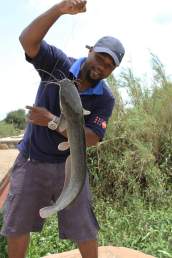
My fishing partner Tsvangi enjoys catching babel.

Having satisfied myself about the security of Mierhoff, the following weekend I was back with my family on a Friday and camped until Sunday. It was an enjoyable experience, and for the next several months I became a regular fisherman at this venue, which was not only safe and clean,but the fishing was also good.

I soon became friends with the owner of the place, a big and hardworking Afrikaans man, who did most of the ground maintenance himself. I eventually discovered other dams which were better at other species of fish since Hartebeespoort was only good for carp. However, I went to the other dams mostly for day fishing as the alternative dams I had discovered did not have good ablution facilities.

This meant that when I wanted to camp, I reverted to Hartebeespoort for its cleanliness and relative safety. I was later to dump Hartebeespoort after learning that fishermen were losing their property -especially cellphones and laptops – to thieves who sneaked in at night when fishermen were asleep, and cut open their tents to steal.

What baffled the owner of Mierhoff was how the thieves gained entry as the gate to the fenced property was locked during the night. The thieves became emboldened by their success, and later I heard they had stolen a fridge from a guesthouse on the premises.

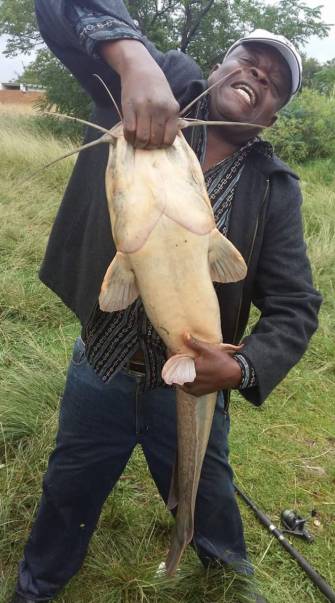
Hartebeespoort boasts big babel

The thefts prompted several fishermen, including me, to stop camping at Mierhoff as it was no longer safe to do so.

Months later, two young men were caught by private investigators who had been hired to try and solve the mysterious thefts. It turned out that the two were stealing in a very clever way. They arrived in the dead of night in a canoe, having pedaled from across the dam. They carried fishing rods, and when they docked at Mierhoff, they acted as if they were some of the campers who were returning from fishing in deep waters during the night.

On that fateful day, little did they know that they were being watched as they performed their usual ritual of docking and moving out – fishing rods in their hands. Watching them from parked cars, the investigators eventually caught the culprits in the middle of the act and arrested them.

When they appeared in a magistrates’ court, the two culprits said they had gotten away with their thieving activity because they carried fishing equipment and appeared as though they were fishing. They said fishermen had not suspected them when they arrived in their canoe with fishing rods, and they proceeded to carry out the thefts.  

Poachers a menace at Roodeplaat dam

Fish at Roodeplaat and Rietvlei dams over fed

For everyone in Pretoria who calls himself or herself a fisherman, is most likely to go Roodeplaat or Rietvlei dams as they are the nearest.

This has resulted in tonnes of bait – especially that for carp – being dumped into the dams, something which may explain why fish have not been biting well at the two dams of late. Most weekends, the two dams are inundated with so-called fishermen, most of whom seem to be much better at boozing than fishing.

I have been fishing at both dams since 2008, and I must point out that both have become pale shadows of what they used to be, prompting me to look for alternative fishing venues, alas much further away from my home in Pretoria.

While the fact that the offloading of bait into the dams each weekend has meant that the fish are always well fed, and has thus contributed to them not biting most of the time, other factors have also contributed – namely poaching and noise.

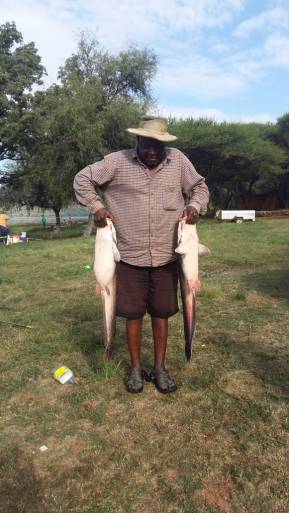
Babel is one of the most plentiful species at Roodeplaat dam.

I was surprised one day when I decided to cross Roodeplat dam in my canoe, to try my luck on the other side of the dam, about 300m from my usual fishing site. Just on my first cast, my line got entangled onto something, and when I went to investigate, I discovered that I had hooked a fishing net. After removing my hook, I decided to follow the line just out of interest, to find out how long it was.

I actually got the shock of my life because the net was incredibly long. In fact, after following it for about 500m, I decided to abandon my investigation after suspecting that the poachers might be watching me from nearby bushes and could hurt me. I immediately rowed back to the other side because I know how dangerous poachers can be if you cross their path, or even if they only suspect you are against their activities.

When I eventually related the encounter to one of my fishing friends who also sometimes fishes from a canoe, he said he had also come across a net and had followed it from one end to another, and estimated it to be about a kilometre long. He said it was actually there permanently, and the poachers just visited it regularly to remove their loot.

That day I also learned something I had not know for years.I had always believed that there are no crocodiles at Roodeplaat dam, only to come across a very big one on that day as I was rowing back to my traditional fishing spot. I immediately remembered what my late father and fishing mentor used to tell me about big water bodies. He always reminded me that I should always suspect that there could be crocodiles in any dam, even if some fishermen told me that there are no crocs, because they might not have seen them as crocs tend to hide from human beings.

The other day when I decided to camp overnight at Roodeplaat dam, I discovered that there are poachers who come in during the evening,pretend to be fishing, but use nets at night, and leave the dam very early in the morning when it is still dark. They obviously do so with the co-operation of security guards because when I reported the matter to the security in the morning, they did not seem too interested.

I have seen this same group of poachers – four of them – at least twice, and they move in a white single cab bakkie. Their favourite poaching spot is by the first gazebo near the river mouth, about 300m from the main gate.

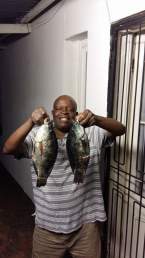
Breams thrive well at Roodeplaat dam.

Around 2008 to 2013 I used to prefer Rietvlei dam over Roodeplaat, but I eventually completely abandoned fishing at Rietvlei for security reasons. Twice I had read in the press of incidents when fishermen were robbed of valuables such as cellphones and laptops, at gun point during the night at Rietvlei dam.

Also I was put off by a corrupt and semi-literate security guard who used to demand bribes from fishermen in order to allow them to leave with fish. I say semi-literate because he insisted that it was illegal to take fish home, yet there was a placard near the entrance which said fishermen were encouraged to practice catch and release for conservation purposes. But they were certainly allowed to take fish home if they so desired.

Roodeplaat has generally been safe, and I have heard of only one incident if an attempted robbery. I have slept there many times without incident.